皆様、お疲れ様です!
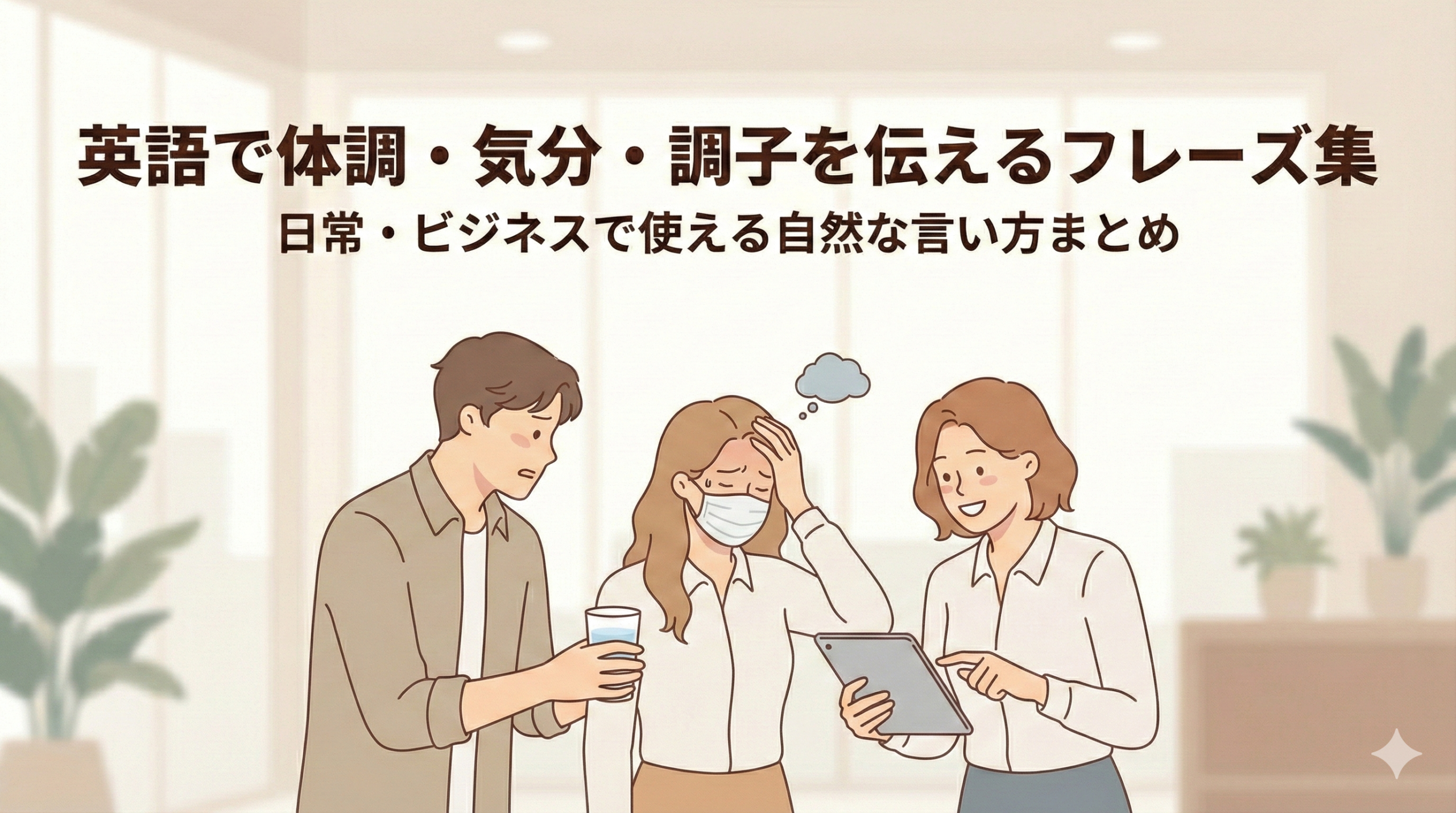
働いているとストレスも溜まるし、体調が悪い時もあります。
そういう時に同僚や上司に伝えておくことで、自分を労われるし、ミスをしてしまった時にカバーしてもらえる確率も上がるはずです。無理せず正直に伝えることで、相手に迷惑をかけず、信頼関係を保てます。
そういうことからも体調を伝える英語フレーズを使えるようになっておくことも大切だと思います。
では英語で「体調が悪い」「疲れている」「元気です」と言いたいとき、何と言いますか?
“I’m fine.” や “I’m tired.” が思い浮かびましたか?
本記事で学習すれば、英語では気分や体調の表現にバリエーションを持たせることができ、会話がぐっと自然になります。
たとえば、
“I’m under the weather.”(少し体調が悪い)
“I feel refreshed today.”(今日はすっきりしています)
のように、状況に合った言い回しを選ぶのがポイントです。
この記事では、英語で気分・調子・体調を伝えるフレーズを、
「元気なとき」「疲れているとき」「体調不良」「ストレス」「気分の良し悪し」などの場面別に紹介します。
ビジネスでも日常でもすぐ使える表現を身につけましょう!
それでは本日も頑張っていきましょう!よろしくお願いいたします!
- 軽い体調不良を伝えるとき(Feeling slightly unwell)
- 疲れを感じているとき(Feeling tired or drained)
- プレゼン・会議前の不安を伝える(Feeling uneasy or nervous)
- 健康状態を説明するとき(Explaining a physical condition)
- 早退・休暇を申し出るとき(Requesting time off due to health)
- 同僚の体調を気遣うとき(Checking on a colleague’s health)
- 回復や復帰を伝えるとき(Talking about recovery or coming back)
軽い体調不良を伝えるとき(Feeling slightly unwell)

I feel like I’m coming down with a cold.
風邪をひき始めた気がします。
(come down with=〜にかかる)

Oh no, make sure to get some rest tonight.
あー、それはいけませんね。今夜はしっかり休んでください。
(get some rest=休む)
I have an upset stomach today.
今日はお腹の調子が良くありません。
(upset stomach=胃の不調)
Sorry to hear that. Would you like to take a break?
それは大変ですね。少し休みますか?
(take a break=休憩する)
IMy body aches all over.
全身がだるいです。
(aches all over=全身が痛い)
You should probably go home early.
早めに帰った方がいいですよ。
(go home early=早退する)
My brain isn’t functioning well this morning.
今朝は頭が働きません。
(function=機能する)
Mondays can be rough. Grab some coffee!
月曜はつらいですよね。コーヒー飲んできてください!
(grab=手早く取る)
I still feel run down after the business trip.
出張の疲れがまだ取れません。
(run down=疲れ切った)
Traveling takes a lot out of you.
出張は本当に体力を使いますからね。
(take out of=疲れさせる)
I’m feeling a bit under the weather today.
今日は少し体調がすぐれません。
(under the weather=体調が悪い)
Hope you get better soon.
早く良くなってくださいね。
(get better=回復する)
My throat feels sore.
喉が痛いです。
(sore=痛い)
Drink some warm tea, it helps a lot.
温かいお茶を飲むといいですよ。
(helps=役立つ)
I’m feeling dizzy.
少しめまいがします。
(dizzy=めまいの)
Maybe sit down for a bit.
少し座って休んでください。
(sit down=座る)
I didn’t sleep well last night.
昨晩あまり眠れませんでした。
(sleep well=よく眠る)
That explains why you look tired.
疲れて見えるのはそのせいですね。
(explain=説明する)
I might go see a doctor after work.
仕事の後で病院に行くかもしれません。
(see a doctor=受診する)
Good idea. Take care of yourself.
いいですね。お大事に。
(take care of yourself=体を大切にする)
疲れを感じているとき(Feeling tired or drained)
I still feel worn out from yesterday’s meeting.
昨日の会議の疲れがまだ取れません。
(worn out=疲れ切った)
That was a long one. You should rest up.
長かったですからね。しっかり休んでください。
(rest up=十分に休む)
It was a physically draining day.
体力的に消耗した一日でした。
(draining=消耗する)
You’ve earned a good rest.
よく頑張りましたね。しっかり休んでください。
(earned=値する)
I’m mentally exhausted after all those reports.
レポート作成で頭が疲れました。
(mentally exhausted=精神的に疲れた)
That’s understandable. Maybe take a short walk.
それは分かります。少し散歩するといいですよ。
(take a walk=歩く)
I feel sluggish this morning.
今朝は体が重いです。
(sluggish=だるい)
Same here. Mondays are always tough.
私もです。月曜はいつもつらいです。
(same here=私も同じ)
My eyes feel strained from staring at the screen all day.
一日中画面を見ていて目が疲れています。
(strained=疲れた)
Try the 20-20-20 rule. It really works.
20分ごとに20秒遠くを見るといいですよ。
(rule=ルール)
I didn’t realize how tired I was until I sat down.
座って初めて疲れに気づきました。
(realize=気づく)
That’s a sign you need a break.
それは休憩が必要なサインですね。
(sign=兆候)
I’m out of shape these days.
最近体力が落ちています。
(out of shape=体がなまっている)
Same here. We should start exercising again.
私もです。運動を再開しないとですね。
(exercise=運動する)
I still feel run down from last week’s overtime.
先週の残業の疲れが取れません。
(run down=疲れ果てる)
Try getting to bed earlier this week.
今週は早めに寝た方がいいですよ。
(get to bed=寝る)
I think I hit my limit today.
今日は限界です。
(hit one’s limit=限界に達する)
You’ve done enough. Let’s call it a day.
もう十分頑張りました。今日は終わりにしましょう。
(call it a day=切り上げる)
My body just feels heavy lately.
最近ずっと体が重いです。
(body feels heavy=だるい)
Maybe it’s stress. Don’t push yourself too hard.
ストレスかもしれません。無理しないでください。
(push oneself=無理する)
プレゼン・会議前の不安を伝える(Feeling uneasy or nervous)
I feel uneasy about the upcoming presentation.
次のプレゼンが不安です。
(uneasy=不安な)
You’ll do great. You’ve prepared well.
きっとうまくいきますよ。しっかり準備していますから。
(do great=うまくやる)
My stomach feels tight before big meetings.
大事な会議の前はお腹がキリキリします。
(stomach tight=緊張)
Happens to everyone. Try breathing deeply.
誰でもそうなりますよ。深呼吸してみてください。
(breathe deeply=深呼吸する)
My hands always shake before I speak.
話す前はいつも手が震えます。
(shake=震える)
That just means you care. It’s a good sign.
それは真剣に取り組んでいる証拠ですよ。
(good sign=良い兆し)
I didn’t sleep much last night.
昨夜あまり眠れませんでした。
(sleep=眠る)
You’ll be fine once you start talking.
話し始めれば大丈夫ですよ。
(once you start=始めれば)
I’m mentally exhausted already, and it’s only 9 AM.
もう精神的に疲れています。まだ9時なのに。
(mentally exhausted=精神的に疲れた)
Mondays can be brutal. Hang in there!
月曜はつらいですよね。頑張って!
(hang in there=踏ん張る)
My voice tends to shake when I’m nervous.
緊張すると声が震えます。
(tend to=〜しがち)
That’s normal. Focus on your breathing.
普通のことです。呼吸に集中してください。
(focus on=集中する)
I keep forgetting my lines during practice.
練習中に台詞を忘れてしまいます。
(forget lines=台詞を忘れる)
That’s okay. You’ll remember once you’re confident.
大丈夫です。自信を持てば自然と思い出しますよ。
(confident=自信がある)
I feel a bit of pressure today.
今日は少しプレッシャーを感じます。
(pressure=重圧)
Pressure means you care about the outcome.
プレッシャーを感じるのは、それだけ真剣ということですよ。
(outcome=結果)
My heart’s pounding before the meeting.
会議前に心臓がドキドキしています。
(pound=鼓動する)
That’s adrenaline kicking in! You’ll be fine.
アドレナリンが出てるだけですよ。大丈夫です。
(kicking in=効き始める)
Thanks for calming me down.
落ち着かせてくれてありがとう。
(calm down=落ち着く)
Anytime. You’ve got this.
いつでも。あなたなら大丈夫。
(you’ve got this=きっとうまくいく)
健康状態を説明するとき(Explaining a physical condition)
I have a sharp pain in my stomach.
お腹に鋭い痛みがあります。
(sharp pain=鋭い痛み)
That sounds serious. You should see a doctor.
それは深刻そうですね。病院に行った方がいいですよ。
(see a doctor=受診する)
I’ve had a chronic shoulder pain for years.
何年も肩こりに悩まされています。
(chronic=慢性的な)
Maybe a massage or stretching could help.
マッサージやストレッチを試してみてはどうですか?
(stretching=体を伸ばす運動)
My eyes feel strained from looking at the screen all day.
一日中画面を見ていて目が疲れています。
(strained=疲れた)
You should take short breaks more often.
もっとこまめに休憩を取った方がいいですよ。
(more often=より頻繁に)
My body aches all over after the trade show.
展示会の後、全身が痛いです。
(aches all over=全身が痛む)
That must have been exhausting.
相当疲れたでしょう。
(exhausting=疲れさせる)
I have an upset stomach from last night’s dinner.
昨晩の食事で胃の調子が悪いです。
(upset stomach=胃の不調)
Drink plenty of water and take it easy.
水をたくさん飲んで、無理せず過ごしてください。
(take it easy=無理しない)
I feel stiff around my neck and shoulders.
首と肩がこっています。
(stiff=こった)
That’s probably from stress or posture.
ストレスか姿勢のせいかもしれませんね。
(posture=姿勢)
I’m out of shape lately because I stopped exercising.
最近運動していないので、体力が落ちています。
(out of shape=体がなまっている)
It happens to everyone. Just start small again.
誰にでもあります。少しずつ再開すれば大丈夫です。
(start small=少しずつ始める)
I have a mild headache today.
今日は軽い頭痛があります。
(mild headache=軽い頭痛)
Maybe you need to step away from the screen.
画面から少し離れた方がいいかもしれません。
(step away=離れる)
I think my allergies are acting up.
アレルギーの症状が出ています。
(acting up=悪化する)
Oh, that’s tough. Don’t forget your medication.
それは大変ですね。薬を忘れずに。
(medication=薬)
My back hurts after sitting too long.
長時間座っていて腰が痛いです。
(back hurts=腰が痛い)
Try standing up every hour. It really helps.
1時間ごとに立ち上がるといいですよ。
(standing up=立ち上がる)
早退・休暇を申し出るとき(Requesting time off due to health)
I don’t feel well today. Would it be okay if I leave early?
今日は体調が悪いので、早退してもいいですか?
(leave early=早退する)
Of course, take care of yourself.
もちろんです。お大事にしてください。
(take care of yourself=体を大事にする)
I might take a sick day tomorrow if I don’t get better.
良くならなければ、明日は病欠にするかもしれません。
(sick day=病欠)
That’s fine. Just let me know in the morning.
構いません。朝に知らせてください。
(let me know=知らせる)
I have a fever and sore throat, so I’ll work from home.
熱と喉の痛みがあるので、在宅勤務にします。
(work from home=在宅勤務する)
Good idea. Rest up and check in when you can.
いい判断です。休んで、できるときに連絡をください。
(rest up=十分に休む)
I caught a cold and I’m not in good shape.
風邪をひいて体調が良くありません。
(caught a cold=風邪をひいた)
No worries. Health comes first.
心配いりません。健康が第一です。
(comes first=最優先)
I need to see a doctor this afternoon.
今日の午後、病院に行く必要があります。
(see a doctor=受診する)
Sure, we can handle things here.
わかりました。こちらは任せてください。
(handle=対応する)
I think I should take a half day off.
半休を取った方が良いと思います。
(half day off=半休)
That’s totally fine. Get some rest.
大丈夫ですよ。ゆっくり休んでください。
(get rest=休む)
I’ve been feeling dizzy since this morning.
朝からめまいがします。
(dizzy=めまいがする)
Please go home and take care of yourself.
家に帰ってゆっくり休んでください。
(take care of yourself=お大事に)
Sorry, I may not make it to the meeting.
申し訳ありません。会議には出られないかもしれません。
(make it=参加する)
No problem. Your health is more important.
問題ありません。体調の方が大事です。
(more important=より大切)
I might need a few days off to recover.
回復するために数日休む必要があるかもしれません。
(recover=回復する)
Take all the time you need.
必要なだけ休んでください。
(take all the time=十分に時間を取る)
I really appreciate your understanding.
ご理解いただきありがとうございます。
(appreciate=感謝する)
Don’t worry about work. Focus on getting better.
仕事のことは気にせず、回復に専念してください。
(focus on=集中する)
同僚の体調を気遣うとき(Checking on a colleague’s health)
You look pale today. Are you feeling okay?
顔色が悪いですが、大丈夫ですか?
(pale=青白い)
I’m fine, just didn’t sleep much last night.
大丈夫です。ただ昨晩あまり眠れませんでした。
(sleep=眠る)
IYou sound a bit tired. Everything alright?
少し疲れているようですが、大丈夫ですか?
(sound tired=疲れて聞こえる)
Yeah, just a busy week. I’ll be fine.
はい、ちょっと忙しかっただけです。大丈夫です。
(be fine=大丈夫)
You seem off today. Is something wrong?
今日は元気がないようですが、どうかしましたか?
(seem off=元気がない)
I think I’m catching a cold.
風邪をひいたかもしれません。
(catch a cold=風邪をひく)
Hope you feel better soon.
早く良くなってくださいね。
(feel better=回復する)
Thanks, I appreciate it.
ありがとうございます。感謝します。
(appreciate=感謝する)
I heard you weren’t feeling well yesterday.
昨日体調が悪かったと聞きました。
(weren’t feeling well=具合が悪かった)
Yeah, but I’m doing much better now.
はい、今はだいぶ良くなりました。
(doing better=回復している)
Make sure to rest over the weekend.
週末はしっかり休んでくださいね。
(make sure to=必ず〜する)
Will do, thanks for checking in.
そうします。気にかけてくれてありがとう。
(check in=気遣う)
You should take it easy today.
今日は無理しないでください。
(take it easy=無理しない)
Thanks, I’ll try to pace myself.
ありがとう。無理せず進めます。
(pace myself=ペースを保つ)
I noticed you’ve been coughing a lot.
咳が多いようですが大丈夫ですか?
(cough=咳をする)
Yeah, it’s just allergies.
はい、ただのアレルギーです。
(allergies=アレルギー)
Do you want me to cover for you in the meeting?
会議、代わりに出ましょうか?
(cover for=代わりを務める)
That’d be great, thank you.
助かります。ありがとうございます。
(that’d be great=そうしてもらえると嬉しい)
Let me know if you need any help.
何か必要なら教えてください。
(let me know=知らせる)
I will. Thanks for being so considerate.
はい。気を使ってくれてありがとう。
(considerate=思いやりのある)
回復や復帰を伝えるとき(Talking about recovery or coming back)
I’m feeling much better today.
今日はだいぶ良くなりました。
(feel better=回復する)
That’s great to hear. Welcome back!
良かったです。お帰りなさい!
(welcome back=復帰を歓迎する)
I took a few days off to rest, and it really helped.
数日休んだおかげで、だいぶ回復しました。
(took days off=休暇を取った)
Perfect. Don’t push yourself too hard.
良かった。無理しすぎないでください。
(push yourself=無理する)
I still feel a bit run down, but I’m getting there.
まだ少し疲れが残っていますが、回復しています。
(run down=疲れている)
Take it easy for a few more days.
あと数日は無理しないでください。
(take it easy=ゆっくりする)
I’m glad to be back at work.
仕事に戻れてうれしいです。
(be back=戻る)
We’re happy to have you back.
戻ってきてくれて嬉しいです。
(have you back=再び迎える)
Thank you for covering for me while I was out.
休んでいる間、代わってくれてありがとうございました。
(cover for=代わりを務める)
No problem at all. I’m glad you’re feeling better.
全然問題ありません。元気になって良かったです。
(no problem at all=全然問題ない)
I learned it’s important to listen to my body.
体の声を聞くことの大切さを学びました。
(listen to one’s body=体調を意識する)
Exactly. Health always comes first.
その通り。健康が一番大事です。
(comes first=最優先)
Thanks for all your messages while I was sick.
体調不良の間、メッセージをありがとう。
(while I was sick=病気の間)
Of course. We were worried about you.
当然ですよ。みんな心配していました。
(worried=心配した)
I’ll take it slow for the first few days.
最初の数日は無理せず進めます。
(take it slow=ゆっくり進める)
That’s a good plan. No need to rush.
いい考えです。急ぐ必要はありません。
(rush=急ぐ)
I’m fully recovered now.
完全に回復しました。
(fully recovered=全快した)
Fantastic. Glad to have you back on the team.
素晴らしい。チームに戻ってくれて嬉しいです。
(glad to have you back=戻ってきて嬉しい)
Thanks again for your patience and support.
ご理解とサポート、改めてありがとうございます。
(patience=忍耐)
Anytime. Health is more important than deadlines.
いつでも。締切より健康の方が大事ですよ。
(more important than=〜より大切)
以上です!お疲れ様でした!
コメント